What a rowing video analysis measures
Rowing technique is mostly about the order things happen in and the positions you hit at the ends of the stroke. Those are hard to judge by eye at 30 strokes a minute. They are easy to measure once a pose model has placed the ankle, knee, hip, shoulder, elbow and wrist on every frame. Mocta-X turns those positions into joint angles, then splits the clip into strokes at each catch and finish.
Each stroke is graded against published reference ranges on 13 checks across four phases. Checks that decide a stroke weigh more than cosmetic ones. The weights are public in the scoring guide.
| Phase | Checks | Heaviest |
|---|---|---|
| Catch | Forward body angle, shin angle, arm extension, knee compression | Forward body angle (1.5) |
| Drive | Legs → back → arms sequence, leg–back connection, handle path | Drive sequence (2.0, the heaviest check) |
| Finish | Layback, leg extension, trunk swing | Layback (1.5) |
| Recovery | Hands → body → knees sequence, body set, slide rhythm | Recovery sequence (1.5) |
You also get stroke rate, how much the rate drifts, your best stroke, and angle curves for knee, elbow and trunk across the whole piece. The rowing technique guide explains what each check looks for.
Two scores: technique and performance
Technique is a 0–100 score with a letter grade: 90 and up is an A, 85 an A−, 80 a B+, 75 a B, 70 a B−, 60 a C, and anything lower a D. It answers one question: how close were your positions and sequencing to the reference, stroke by stroke?
Performance answers a different one: did your technique hold up across the piece? It is built from three parts:
- Consistency (40%): how tightly your positions cluster, and how well you held rate.
- Durability (35%): how far your positions drifted as the piece went on, and the stroke where the shape broke.
- Efficiency (25%): sequencing, connection, handle path and slide rhythm.
The targets depend on the style you pick: Recreational/Fitness (the default), Competitive/Sprint, Masters/Long-distance, or Technical/Coaching. A masters sculler isn't judged against a sprint eight.
Erg, on-water and crews
On the erg, the camera sees everything: feet, the full slide and the handle. Every check is graded. See erg technique analysis for set-up and the faults it catches most often.
On the water, the hull hides shins and ankles and the oar handle travels in an arc. Mocta-X doesn't guess at what it can't see. Hidden joints are marked unmeasured and carry no weight, handle path isn't graded, and tracking quality is judged on the trunk. See on-water rowing video analysis.
Crews: one side-on clip of the boat gives you each rower's stroke phase and a sync score for every pair, so you can see where the boat moves together and where it doesn't.
An AI coach that cites the frame
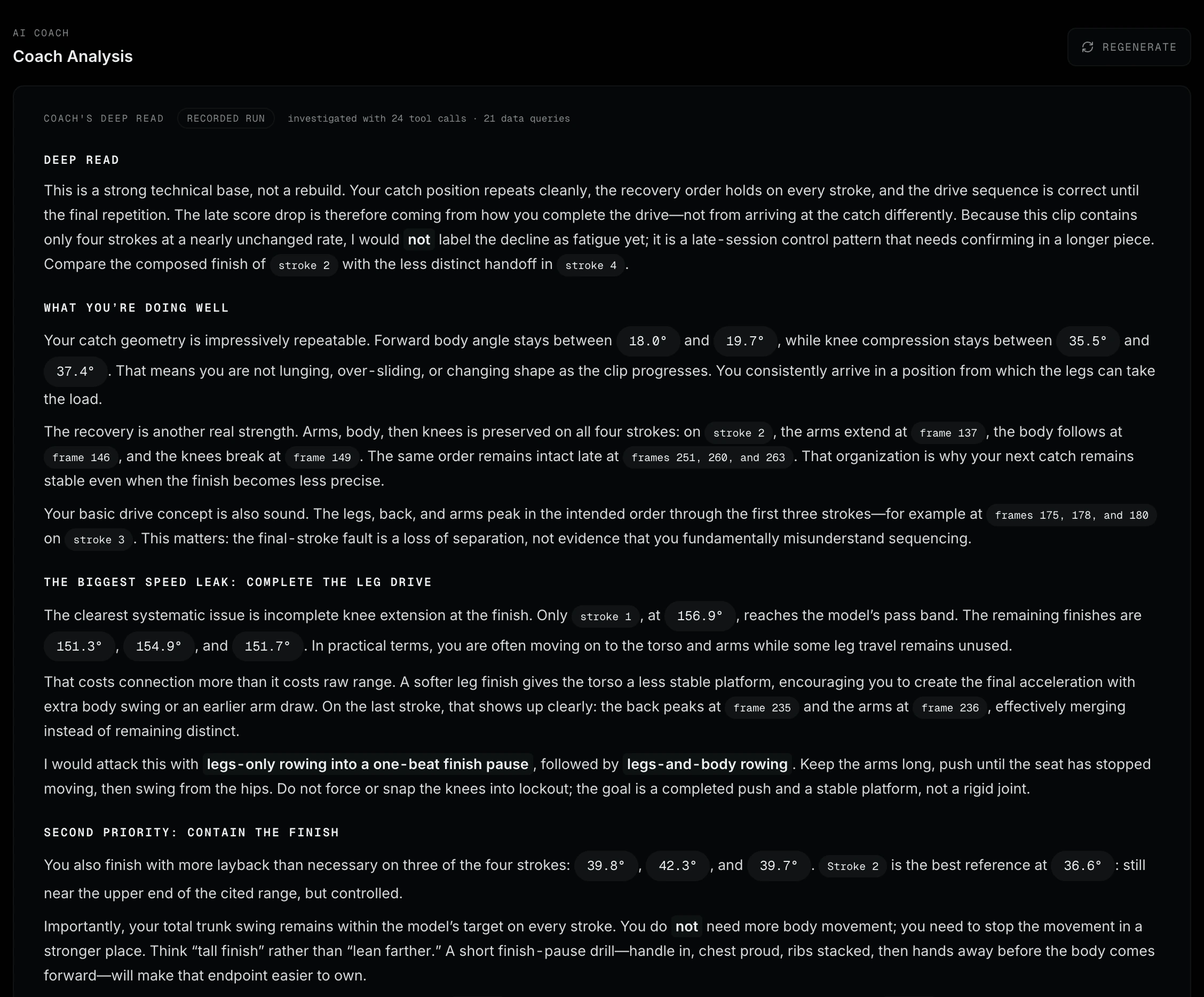
Scores don't tell you what to change. The coach reads your analysis the way a person would: it looks up specific strokes, pulls one metric across the whole piece, compares your best stroke to your worst, and checks your history. It shows that trail as it works. Every point links back to the stroke and frame it came from, so you can scrub straight to the moment and check it yourself. How the AI rowing coach works goes through its tools and limits.
When it won't give you a score
A confident number from a bad clip is worse than no number. Mocta-X withholds the technique score unless at least half the frames are usable, at least three strokes can be graded, and the capture-quality check passes. That check covers camera angle, how much of the frame the rower fills, and (on the erg) whether the feet are in shot. When a score is withheld, you're told exactly what to fix.
Getting a gradeable clip takes about a minute of set-up. How to film rowing for video analysis covers camera angle, height and distance.
Web, iPhone and clubs
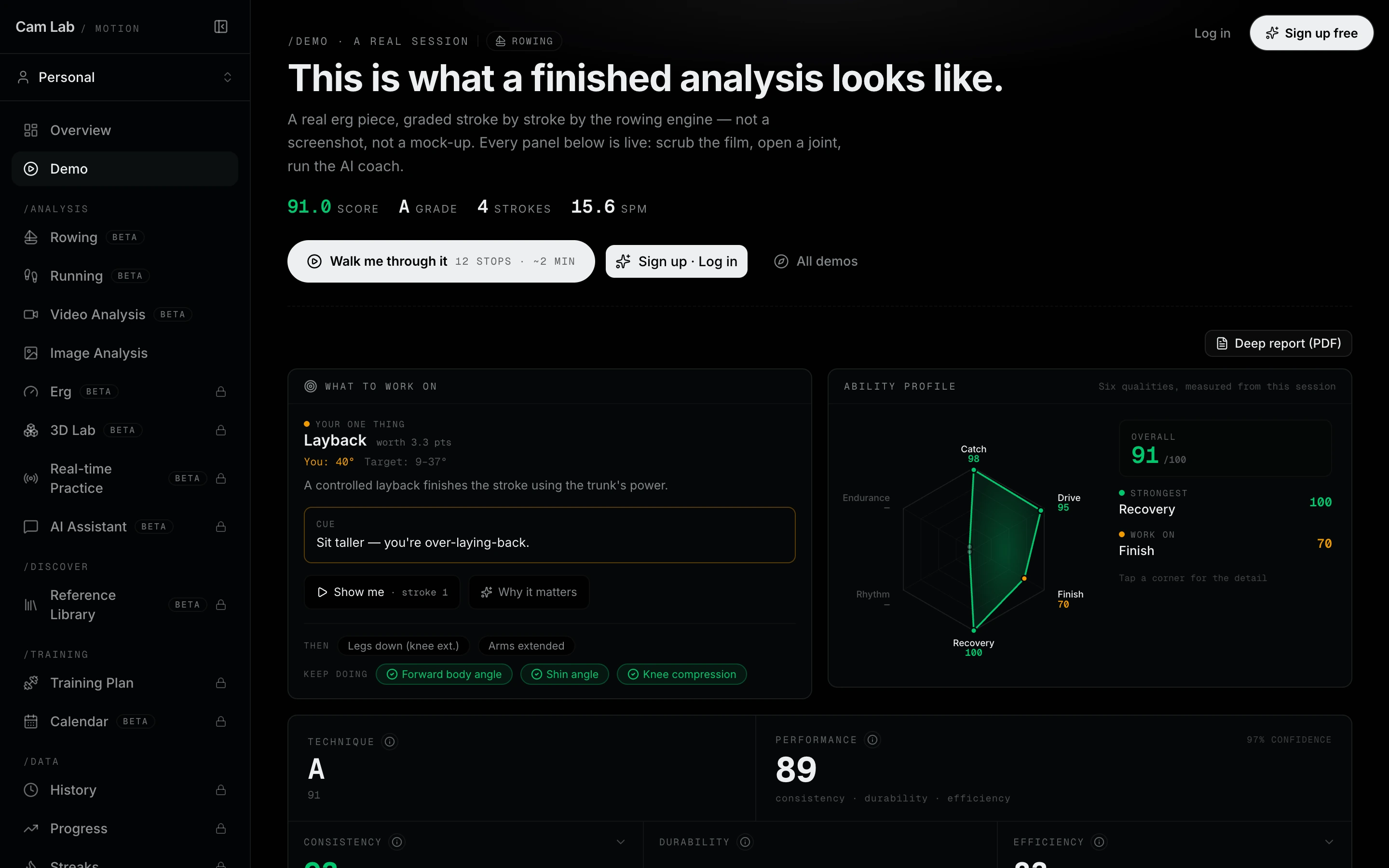
- Mocta-X Dashboard runs in any browser. Upload a clip, then scrub the skeleton, the joint inspector, the speed-and-sequence chart and a 3D view.
- Mocta-X for iPhone adds a capture wizard, a PM5 connection over Bluetooth, Concept2 Logbook sync, and a live voice coach on the erg. It is currently a public TestFlight beta.
- For coaches and clubs: coach comments drafted in your own voice, a shared film room, and public erg-test leaderboards with capture stations.
The free plan gives you two analyses a day with clips up to 30 seconds. Pro ($9.99 a month) raises that to 20 a day and 2-minute clips; Elite ($29.99) goes further. See pricing for every limit.
Questions
Can I analyse rowing technique from a phone video?
Yes. A side-on clip from any phone is enough: at least five or six unbroken strokes, with the rower filling most of the frame. Mocta-X tracks the skeleton on every frame, splits the clip into strokes and grades each one.
Does it work for on-water rowing, or only the erg?
Both. On the water, joints hidden by the hull are marked unmeasured and carry no weight rather than being guessed, and handle path isn't graded because the oar handle arcs. Crew clips are supported too, with a sync score for every pair of rowers.
What does the technique grade mean?
It is a 0–100 score from 13 weighted checks across catch, drive, finish and recovery. 90+ is an A, 80 a B+, 70 a B−, 60 a C. The checks and weights are published in the scoring guide.
Is rowing video analysis free?
The free plan includes two analyses a day with clips up to 30 seconds. Pro is $9.99 a month and Elite $29.99, both with a 7-day trial.
How accurate is it?
It is highly repeatable: after calibration, re-grading the same clip changed the score by 0.6 points on average across 57 sessions, and by 3 points at worst. It has not yet been validated against marker-based motion capture, and single-camera tracking degrades when the camera is more than about 20–25° off side-on.