How the coach works
A rowing video analysis happens first. A pose model places 33 landmarks on every frame, the clip is split into strokes at each catch and finish, and 13 technique checks are graded on every stroke. That produces a lot of numbers: per-stroke scores, the checks that failed on each stroke, joint-angle curves, stroke rate and how it drifted, and three performance pillars for consistency, durability and efficiency.
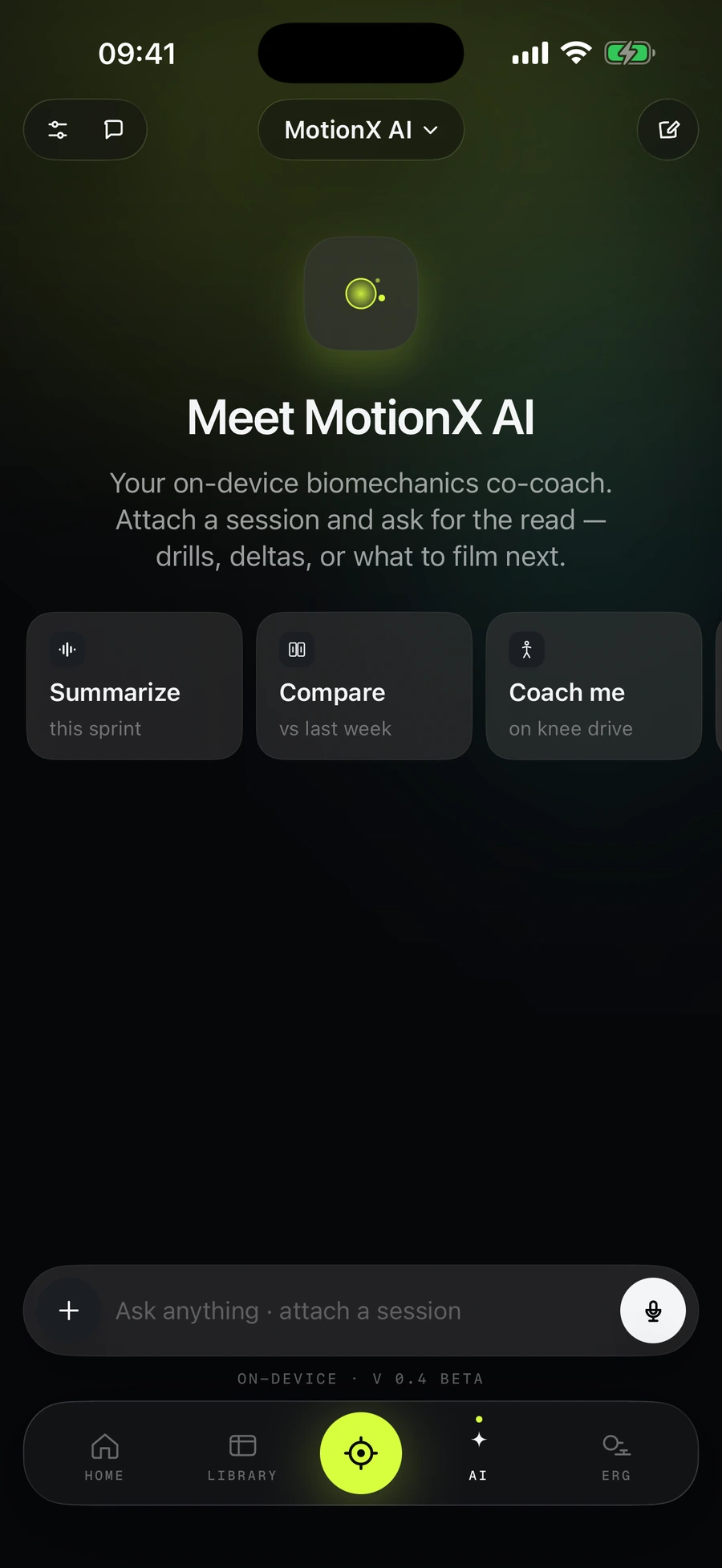
The coach is a frontier language model with tools, and the tools are the only way it can learn anything about your rowing. It can open a session summary, pull one stroke in full with every check's measured value and target band, compare two strokes, read one metric across every stroke in the piece, get the angle series for a joint, read your durability and efficiency breakdowns, and read your history and the cues it gave you last time. It cannot see the video, and it cannot invent a number the grader didn't produce.
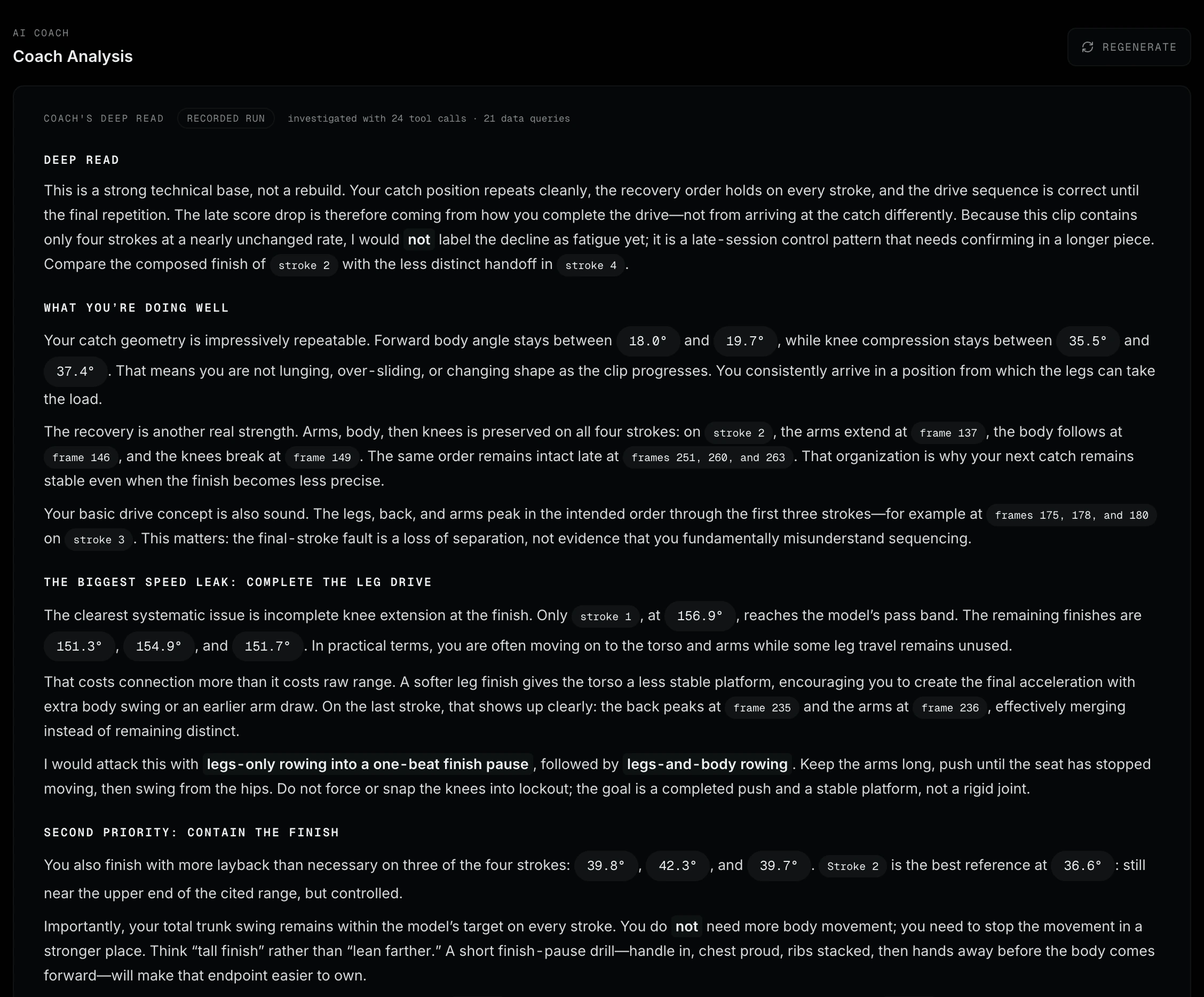
- It investigates first. A coaching turn starts with tool calls, not prose. The trail of what it read is shown in the interface, so you can see it opened stroke 14 before it told you about stroke 14.
- It cites. Every point in the write-up names the stroke and the frame it came from, and tapping it jumps the player there.
- It says when it doesn't know. If a check was withheld because the capture was poor, or a joint was hidden by the hull on the water, the coach says so rather than filling the gap.
- It remembers. History includes the cues it gave last session, so it can tell you whether the last thing it asked for actually changed.
What a read looks like
The coach's job is to pick the fault that is costing you most, show you where it is clearest, and say what to change. A typical read on an erg piece: which of the 13 checks failed most often, the stroke where it was worst, whether it got worse as you tired (from the durability pillar), and one drill from the common mistakes list to work on before the next clip.
You can then ask it anything about the piece. Why did my rate drift after stroke 30? Is my layback different from last week? Which stroke should I look at for shooting the slide? Each answer is another investigation, not a recollection.
It knows who it is coaching
The coach reads your profile, which includes height, weight, age, level, goals and injury notes, and your recent check-ins for mood, effort, sleep and soreness. Advice about load and priorities is built on that, and the coach is told never to guess a field you haven't filled in. On the erg, it can also read your Concept2 profile, personal bests and pace curve, so a technique read can be put next to what the split was doing at the same point.
Coaches get more. In a club, the same coach can read the roster, each athlete's latest session, practice context and the calendar, and draft feedback on an athlete's session in the coach's own voice from the analysis. Nothing reaches the athlete until the coach publishes it. See rowing for coaches and clubs.
A live voice coach on the erg
On iPhone, Mocta-X for iPhone connects to a Concept2 PM5 over Bluetooth. On the Elite plan, a live voice coach reads your split, stroke rate, heart rate and target while you row, and talks to you through the piece. It is built from the same erg rubric and the same data tools as the written coach, so the voice in your ear is working from the numbers on the monitor, not a script.
Training plans it can write
Ask for a plan and the coach reads the training-science library first: cited digests of what the rowing literature and the major training systems agree on for zones, polarized training, periodization, 2k preparation, tapering, returning from a break, strength, masters and injury. It builds the plan on that and on your profile and history, and explains the principle in plain words. You accept it into your calendar, and on iPhone the sessions can run against the PM5.
Limits, plainly
- It measures body positions and timing. Not boat speed, not force, not blade work. A coach on the bank still sees things a phone clip doesn't.
- It is only as good as the clip. Filmed off-axis or too far away, checks are withheld and the coach says so. How to film rowing is a one-minute set-up.
- It is not validated against a motion-capture lab. The analysis is highly repeatable (re-grading the same clip moves the score by 3 points at worst), and single-camera pose estimation is a few degrees off marker-based capture in independent studies. The methodology page has the numbers.
- Message limits. Free plans include five coach messages a day with the standard coach. Pro raises that to 100 a day with the streaming coach and PDF reports; Elite is unlimited and adds the live voice coach. See pricing.
Questions
Does the AI coach watch my video?
No. It reads the graded analysis through tools: strokes, checks, angles, consistency, history and your profile. Raw video is never sent to an AI provider.
How is this different from an AI that describes my rowing from a video?
A model describing a video is guessing angles and timing by eye, the way a person would. Mocta-X's coach can only speak from measurements the grader produced, and it has to cite the stroke and frame for each claim.
Can I ask it follow-up questions?
Yes. Every question is a new investigation: it re-queries the session rather than answering from memory. Free plans include five messages a day, Pro 100, Elite unlimited.
Does it work for on-water rowing?
Yes. On the water, joints hidden by the hull are unmeasured rather than guessed, and the coach is told which checks were withheld, so it doesn't comment on legs it can't see.
Does it coach running and golf too?
The same coach reads running and golf sessions, with their joint scores, phase analysis and recommendations. The stroke-level tools described here are specific to rowing.
Which AI model is it?
A frontier language model, given tools. We don't name the model on this site because the choice changes as better ones ship; what stays fixed is that it must read the measurements and cite them.